No Providence
Affiliate disclosure: As an Amazon Associate I earn from qualifying purchases. Amazon and Barnes & Noble links on this page are affiliate links; purchases may earn Soldier on Fire a commission at no extra cost to you.
What False Accusations Teach You About Faith, Fear, and Forced Decisions
Understanding Plea Agreements, Coerced Consent, and the Moment You Realize the System Doesn't Care About Your Innocence

Let me ask you something most people in your situation have never been asked directly:
Have you made any of the decisions in your legal case freely?
Not “were you forced at gunpoint.” Not “did someone put a document in front of you and make you sign it.” I mean genuinely, truly freely — with full information, full options, full time to decide, and no sword hanging over your head?
Because here is what the legal system rarely acknowledges, what your attorney may or may not tell you directly, and what almost nobody outside of the law profession understands:

Understanding what “no providence” actually means — legally, psychologically, spiritually — could be the most important thing you read today. Because if you are facing a false accusation and a plea agreement has been placed in front of you, you need to know exactly what you are being asked to give up, what your rights actually are, and what role fear versus faith should play in the biggest decision of your life.

What Is a Plea Agreement — And Why Does It Feel Like a Trap?
A plea agreement — also called a pretrial agreement or plea deal — is an arrangement between the prosecution and the defense in which the accused agrees to plead guilty (or no contest) to one or more charges, usually in exchange for reduced charges, a lighter sentence, or both.
On paper, it sounds reasonable. In practice, for someone who is innocent, it is one of the most psychologically devastating things that can happen.
The Innocence Project — the nonprofit legal organization that has exonerated over 200 wrongfully convicted individuals through DNA evidence — has documented case after case in which innocent people accepted plea deals to avoid the risk of a harsher sentence at trial. Not because they were guilty. But because the trial system is so unpredictable, so financially exhausting, and so psychologically brutal, that the “certain” outcome of a plea felt safer than the uncertain outcome of justice.
That calculation is understandable. It is also one of the greatest injustices built into the American legal system.
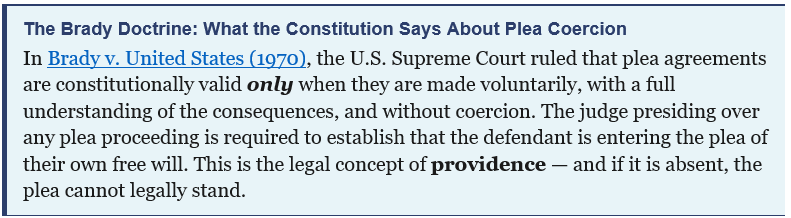
Military Plea Agreements: The UCMJ and Pretrial Agreements
In the military justice system, plea agreements operate under the Uniform Code of Military Justice (UCMJ) and are governed by Rules for Courts-Martial (RCM) 705. Military pretrial agreements — the equivalent of civilian plea deals — can take several forms depending on the level of court-martial involved.
The Three Levels of Military Court-Martial
Understanding the level of court-martial in your case is critical because it determines your rights, your potential sentence, and your appeal options:
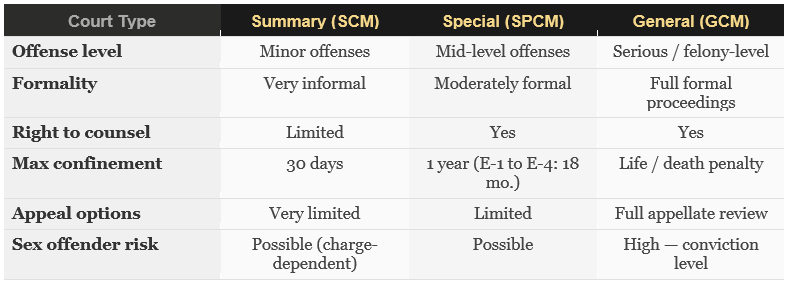
The Summary Court-Martial (SCM) is the lowest level of military court, typically used for minor offenses and designed for speed and efficiency. It can seem like the path of least resistance when you're exhausted, broke, and desperate to go home to your family. But before you consider it, you need to understand what you might be trading away.
The Anatomy of a Plea Deal: What You're Really Being Asked to Sign
Let's break down what a typical military or civilian plea agreement actually involves — because the gap between how it is presented and what it actually means can cost you the rest of your life.
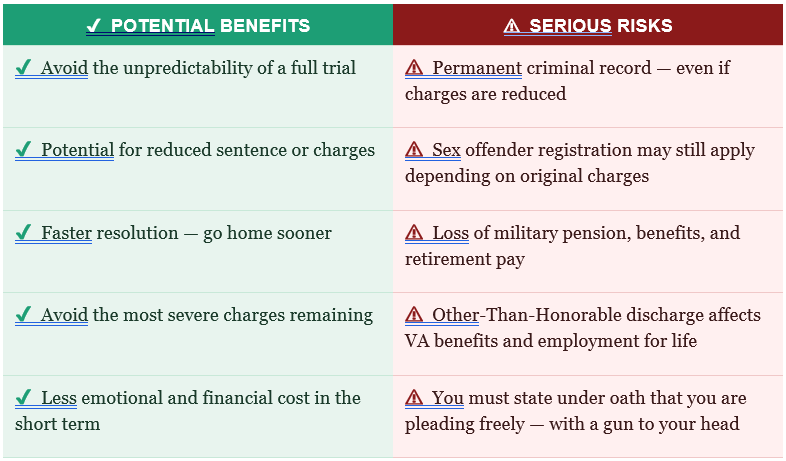
That last con is the one that most people don't think about until they're sitting in front of a judge. When you enter a plea, the judge will ask you directly: “Is this decision being made of your own free will? Has anyone threatened you or forced you into this plea?”
If you answer yes — that it is your free will — but inside you know the answer is no, you have just committed perjury. If you answer honestly and say no, the judge is legally required to reject the plea.
This is the legal concept of providence in its most practical form. And for the falsely accused, it is rarely present.
UNDERSTANDING YOUR LEGAL RIGHTS - RECOMMENDED RESOURCES
Before Taking a Plea — Master Sergeant Gustave (Soldier on Fire Series eBook) — release updates
Written specifically for service members and veterans navigating the military justice system. Know what you're signing before you sign it.
The Innocent Man — John Grisham
A true story of wrongful conviction and the devastating consequences of a broken plea system. Essential reading for anyone facing a false accusation.
Criminal Law: Cases and Materials — Kadish, Schulhofer, Steiker
Comprehensive legal reference on plea agreements, coercion doctrine, and the constitutional requirements of voluntary consent.
Coercion, Consent, and the Pressure That Isn't Called Pressure
Here's what the system will never call it, but what it unquestionably is: coercion by circumstance.
The prosecution doesn't need to threaten you directly. The circumstances threaten you for them:
You're facing a potential decade-long sentence if you go to trial and lose.
You've already been under investigation for 12, 18, 24 months.
Your savings are gone. Your family is fraying. Your mental health is in crisis.
The trial date is 10 months away, and every month of waiting is another month your life is on hold.
Your attorney — as good as they may be — tells you the system is unpredictable.
Under those conditions, a plea deal that offers any relief can start to look rational. Even if it requires you to plead guilty to something you didn't do. Even if it costs you your pension. Even if it requires you to sign your name to a lie.
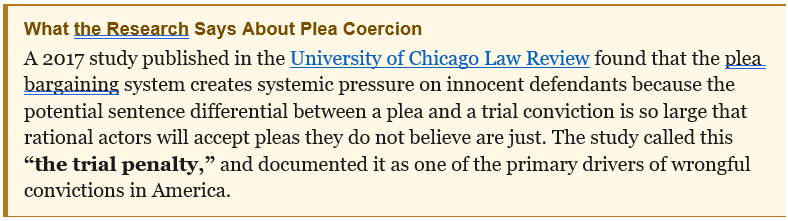
The National Association of Criminal Defense Lawyers (NACDL) has published an entire report called “The Trial Penalty: The Sixth Amendment Right to Trial on the Verge of Extinction,” documenting how the gap between plea sentences and trial sentences has become so extreme that it effectively coerces innocent people into guilty pleas.
This is not a fringe concern. This is a documented, widely recognized structural problem with the American justice system. And it disproportionately affects the most vulnerable defendants: those with limited resources, those facing the most serious charges, and those — like falsely accused veterans — who are navigating a system designed to process guilt rather than establish truth.
The Sex Offender Registry: The Consequence Nobody Explains Clearly
If your false accusation involves any sexual misconduct charge — whether you are ultimately convicted, plead guilty, or even plead to a reduced charge — you may be required to register as a sex offender. This is one of the most catastrophically life-altering consequences in American law, and it is one that is frequently buried in the fine print of plea discussions.
What Sex Offender Registration Actually Means
Under the Sex Offender Registration and Notification Act (SORNA), registration requirements vary by state but typically include:
Public listing of your name, address, photo, and offense on a searchable database
Regular check-ins with law enforcement (quarterly, semi-annually, or annually depending on tier)
Restrictions on where you can live — typically prohibiting proximity to schools, parks, and daycare centers
Restrictions on employment in many industries
Mandatory notification to neighbors and employers when you move
Registration requirements that can follow you for 15 years, 25 years, or life
The Prison Policy Initiative has documented how sex offender registry requirements effectively create a permanent secondary punishment that extends far beyond any sentence served. For a falsely accused person, having this attached to your name is not just unjust — it is civilization-ending in its practical effects.
If your plea agreement involves any charge that carries registration requirements, you must understand this fully before you sign anything. This is non-negotiable. Ask your attorney explicitly: “Will this plea require me to register as a sex offender? In any state? For how long?”
No Providence: When Consent Is an Illusion
Let's go back to the word that anchors this entire blog: providence.
In theology, providence refers to God's guiding hand in human affairs — the sense that there is a higher order, a larger plan, a purpose behind events even when we cannot see it. When facing a false accusation, the absence of providence — that void where faith used to be, that silence where God seemed to have gone quiet — is one of the most spiritually destabilizing experiences a person can face.
But providence is also a legal term. In court, when a judge asks whether a plea was made with “providence,” they are asking whether it was made with full consent, full understanding, and genuine free will. The two meanings — theological and legal — are not as far apart as they might seem.
Both describe the same question: was this decision truly yours?
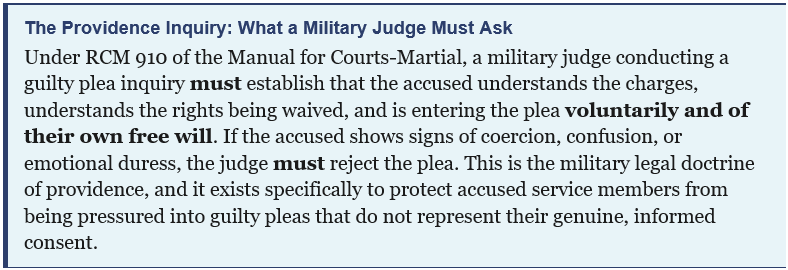
What this means practically: if you are sitting at a plea proceeding and you are not genuinely consenting — if there is a metaphorical gun to your head, if you are doing this out of pure fear and exhaustion rather than informed agreement — your attorney has an obligation to raise this. And the judge has an obligation to reject the plea.
If this didn't happen in your case. If you signed something under conditions that could reasonably be described as coercive. If you didn't feel like you had any real choice. Talk to an attorney about whether your plea had providence. Because if it didn't, the door may not be entirely closed.
SOLDIER ON FIRE SERIES - BOOKS THAT TELL THE TRUTH ABOUT THE SYSTEM
Liar, Liar, Soldier on Fire — Hardcover
The full story of navigating false accusations, a coercive plea process, and the military justice system. The chapter on “No Providence” has helped veterans across the country understand their rights.
Liar, Liar, Soldier on Fire — Paperback
Paperback edition. Perfect for sharing with military legal counsel, family members, chaplains, or anyone in your support network.
Fabricating a Victim — Master Sergeant Gustave (Soldier on Fire Series eBook) — release updates
A deep dive into how fabricated victimhood works, the legal categories it falls into, and how to recognize it in your own case.
Disclosure: As an Amazon Associate and Google affiliate partner, Soldier on Fire LLC earns from qualifying purchases at no extra cost to you. Your support funds veteran advocacy and ministry resources.
Prefer Barnes & Noble? Buy Liar, Liar, Soldier on Fire in hardcover at Barnes & Noble.
Faith in the Absence of Providence: What Keeps You Standing
I want to be honest about something.
There are moments in a false accusation ordeal when faith does not feel like a warm, comforting presence. It feels like an empty room. Like praying into silence. Like reading Bible verses that you used to believe but can no longer feel. Like watching other people's lives move forward while yours is frozen in a legal case that has consumed everything.
That is the experience of “no providence.” Not the absence of God. But the felt absence of His hand. The silence between the prayer and the answer. The darkness before the dawn.
And here is what I have learned, and what I want to pass on to you: faith is not built on guarantees. It is built on the willingness to trust in the unseen, to hope in the silence, and to persevere through the void.

Notice what Jesus did not say. He did not say “here on earth you might face some difficulties.” He said “you will have many trials and sorrows.” Guaranteed. Factual. Expected. And then: “take heart, because I have overcome the world.”
That is not a promise that your trial will go your way. It is a promise that the One who sits above the system has already won. Your job is to hold on long enough to walk into your chapter of that victory.

Practical Guidance: If a Plea Agreement Is in Front of You Right Now
If you are staring at a plea agreement or facing pressure from prosecutors, your chain of command, or even well-meaning family members to “just end this,” here is a practical framework:
1. Do not sign anything under acute emotional distress. If you are in the middle of a panic attack, a depressive episode, or a state of fear-driven desperation, you are not in the condition required for legal “providence.” Tell your attorney you need time. You are legally entitled to reasonable time to consider.
2. Get an independent second opinion. If your assigned military defense attorney is advising you to take a plea and your gut says no, you have the right to request a different attorney or to consult civilian military defense counsel. Organizations like the National Institute of Military Justice can provide referrals.
3. Understand every single consequence before you sign. Criminal record. Sex offender registry (yes or no — in writing). Loss of pension and benefits. Type of discharge and its lifelong employment and VA implications. Future appeal rights. Get all of this in writing.
4. Ask explicitly about providence. Tell your attorney: “I am not sure I can truthfully say to a judge that I am making this decision freely. What happens if I can't?” Watch their answer carefully.
5. Consider the long game, not just today. A plea that ends the immediate pain may create a decade of suffering through registration requirements, employment barriers, and destroyed benefits. Calculate the full cost, not just the immediate relief.
6. Connect with veterans' legal organizations. The Veterans Legal Services Clinic at Yale Law School, the Military Law Task Force, and Protect Our Defenders all provide advocacy and resources for service members navigating the military justice system.
Final Word: Your Decision Must Be Truly Yours
Here is the bottom line, and I want you to hold onto it:

The legal system has enormous power. It can outlast you financially. It can outlast you emotionally. It can pressure you, exhaust you, and make you feel like there is no path forward except the one the prosecution is offering.
But a decision made without providence — without true consent, without genuine free will — is not justice. It is capitulation. And if you are innocent, capitulation does not bring peace. It brings a different kind of prison — one that lives inside you long after any legal sentence is served.
Fight for the path that lets you sleep at night. Fight for the outcome that your children can understand when they're old enough to hear the truth. Fight for the verdict that reflects who you actually are.
The storm tests the ship. But it doesn't have to sink it.
Hold on. Keep the faith. Demand your providence.
— Master Sergeant Everell Gustave
Author, Liar, Liar, Soldier on Fire | Founder, Soldier on Fire LLC
Connect with SOLDIER ON FIRE
You don't have to walk this alone. Soldier on Fire is here for veterans, families, and believers in the middle of their hardest seasons.
Website: soldieronfire.net
Get the book: Liar, Liar, Soldier on Fire on Amazon
Prefer Barnes & Noble? Buy Liar, Liar, Soldier on Fire in hardcover at Barnes & Noble.