
Social Pariah
Affiliate disclosure: As an Amazon Associate I earn from qualifying purchases. Amazon and Barnes & Noble links on this page are affiliate links; purchases may earn Soldier on Fire a commission at no extra cost to you.
From Wounded to Wise
What Happens to Every Relationship You Have When You're Falsely Accused and How to Rebuild From the Ground Up
By Master Sergeant Gustave · Soldier on Fire Series ·
You already know about the legal battle. The attorney fees. The sleepless nights. The courtroom. The accusations.
But there is a part of a false accusation that nobody really prepares you for, a part that can hurt just as deeply as anything that happens in a courtroom, and often lasts far longer:

Not strangers. Not coworkers. Not social media followers. Family. Friends. People whose numbers are still in your phone. People who sat at your Thanksgiving table. People whose kids you coached. People you deployed with, prayed with, and showed up for who now don't answer when you call.
This is what it means to become a social pariah. And if you are going through a false accusation right now, there is a very real chance it is already happening to you.
This blog is about what social ostracism during a false accusation actually looks like, why it happens, what the research says about its effects, and most importantly, how people who have been through it come out the other side not just surviving, but transformed.

What Is a Social Pariah? The Definition Has Never Been More Relevant
A social pariah is a person who has been rejected, shunned, or excluded by their community or social group. The term originates from the Paraiyar caste in South India, a group treated as untouchable regardless of their individual character, worth, or actions. Being associated with that identity was enough to trigger universal exclusion.
Sound familiar?
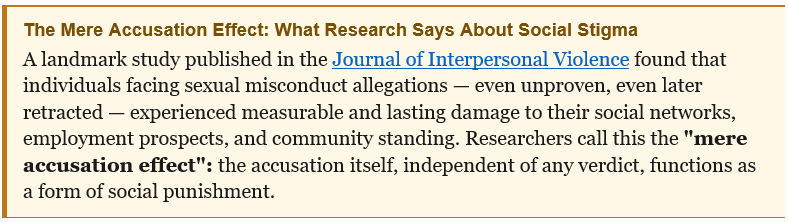
When a false accusation enters your life, especially one tied to sexual misconduct, fraud, or any charge carrying public stigma, something happens almost immediately in your social world. Before any evidence is examined. Before any verdict is reached. Before you have had a single opportunity to tell your side of the story:
People begin to distance themselves.
Not all at once. Sometimes slowly. A friend who stops texting back as quickly. A colleague who doesn't include you in the group chat anymore. A family member who was always at every gathering suddenly has a conflict. A neighbor who used to wave now looks the other way.
And then one day you look around and realize: your world has gotten very small.
Why People Pull Away: The Psychology of Social Abandonment
Before we talk about what to do about it, we need to understand why it happens. Because understanding the psychology behind the abandonment is what keeps you from internalizing it as a verdict on your worth.
1. Fear of Contamination
Social psychologists call this “stigma by association” or “courtesy stigma.” Research by Erving Goffman, whose foundational work on social stigma remains essential reading, documented how people physically and socially distance themselves from the stigmatized not because of any personal offense, but because they fear that proximity to stigma will be transferred to them.
In plain English: they're not pulling away from you because they believe you're guilty. They're pulling away because they don't want people to think they are involved in something that could hurt them. It's self-protection, not judgment. Understanding this doesn't make it hurt less. But it does mean it's not a verdict on who you are.
2. Information Asymmetry
When an accusation goes public, whether through official channels, social media, or word of mouth, the people in your social world are suddenly receiving information they don't know how to process. They weren't in the room. They don't have the full story. And most of them, because of your legal situation, can't hear your side yet.
So they do what humans do with incomplete information: they fill in the gaps with assumptions. And unfortunately, the most dramatic narrative, the accusation, tends to fill those gaps first. This is not malice. It is a cognitive limitation. But it is also why narrative control matters so deeply in cases of false accusation.
3. Conflict Avoidance
Some people disappear not because they believe you're guilty, but because they genuinely don't know what to say, don't want to get involved in something messy, or are afraid that any statement of support could be used against you or against them in proceedings.
This is especially common in military and professional contexts, where the institutional culture strongly discourages associating publicly with anyone under investigation. People who privately believe you are innocent will sometimes stay silent publicly, not out of cowardice, but out of genuine institutional fear.
Understanding Social Stigma & Rebuilding Identity
Stigma: Notes on the Management of Spoiled Identity — Erving Goffman
The foundational academic work on social stigma and how individuals navigate societal rejection. Essential reading for understanding what is happening to you and why.
Liar, Liar, Soldier on Fire — Hardcover (Master Sergeant Gustave)
A first-person account of becoming a social pariah after a false accusation — and rebuilding a life, a faith, and an identity from the ground up.
The Gift of Being Yourself — David G. Benner
A faith-based guide to reclaiming your God-given identity when the world has tried to define you by a label you didn't earn.
Affiliate links: As an Amazon Associate I earn from qualifying purchases. Purchases through Amazon and Barnes & Noble links may earn Soldier on Fire a commission at no extra cost to you.
Prefer Barnes & Noble? Buy Liar, Liar, Soldier on Fire in hardcover at Barnes & Noble.
The Three Waves of Social Abandonment
Social isolation during a false accusation does not arrive all at once. It comes in waves. And recognizing the pattern can help you navigate each one:
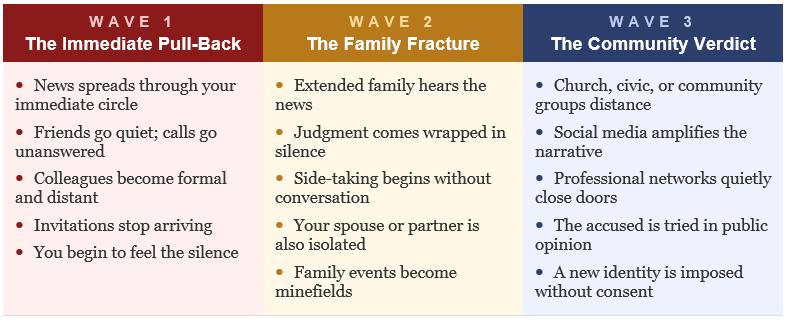
This three-wave pattern has been documented by researchers studying wrongful convictions and their social aftermath. The Innocence Project — which has exonerated over 200 wrongfully convicted individuals has noted that social rebuilding is often harder and longer than legal exoneration itself. Because while a court can clear your name legally, it cannot force your community to update its understanding of who you are.
Cancel Culture, Social Media, and the Modern False Accusation
We cannot talk about the social dimensions of false accusations in 2026 without talking about cancel culture, the social media-driven phenomenon in which a person is publicly condemned, boycotted, and effectively “deleted” from their community based on an accusation, a past action, or an association.
Cancel culture has made the social pariah experience exponentially worse for the falsely accused. Here's why:
Speed: Social media can disseminate an accusation globally within hours, long before any facts have been established. The audience for the accusation is effectively unlimited.
Permanence: Google never forgets. Posts don't disappear. Screenshots circulate indefinitely. A false accusation can haunt a person's digital identity for years after legal vindication.
Mob dynamics: Social media algorithms reward outrage and engagement. A false accusation can trigger coordinated pile-ons from people who have never met the accused and have no stake in the truth.
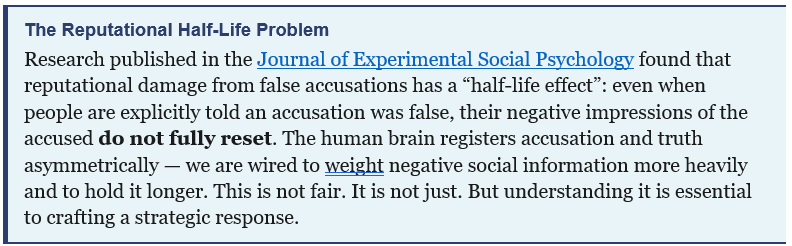
Asymmetry: The accusation travels at the speed of a tweet. The correction, if it comes at all, travels at the speed of a press release. The audience for the accusation is always larger than the audience for the exoneration.
High-profile cases like Depp v. Heard, the Duke Lacrosse case, and dozens of others have put this dynamic into mainstream public consciousness. But for every high-profile case that gets corrected in the public eye, there are thousands of ordinary people, teachers, soldiers, coaches, pastors, professionals whose social destruction never gets a headline.
The Real Victims of Your Social Pariah Status: Your Spouse and Children
Here is something that rarely gets said and needs to be said plainly:
When you become a social pariah, your family becomes one too.
Your spouse did not choose this accusation. Your children did not choose it. But they will experience the same silence, the same side-eyes, the same invitations that stop coming, the same church members who suddenly don't know quite what to say.
Research on secondary trauma in families of the falsely accused is limited but growing. What we do know, from studies by the National Center for Victims of Crime and others, is that spouses and children of people under serious allegations often experience:
Anxiety and depression are tied to social uncertainty and instability
Social withdrawal to avoid questions they can't answer
Academic and professional disruption as the cloud follows the family name
A specific grief that has no recognized name, mourning the life they expected to have
Profound loneliness, because friends and family who might support them don't know how
If you have a spouse, partner, or children living in the shadow of your case right now, please hear this: their pain is real, their isolation is real, and they need support just as much as you do. They have done nothing wrong. And they deserve to be seen in this.
For your family: Resources for spouses and children of the falsely accused
The Body Keeps the Score — Bessel van der Kolk, M.D.
Understanding how trauma lives in the body — essential for spouses and family members processing secondary trauma from a loved one's false accusation.
Liar, Liar, Soldier on Fire — Paperback (Master Sergeant Gustave)
The paperback edition. Share it with your family, your counselor, or your pastor. The chapter on becoming a social pariah speaks directly to the family experience.
Hold On to Your Kids — Gordon Neufeld & Gabor Maté
A research-backed guide for protecting children's attachment and emotional security during periods of family instability and social upheaval.
Affiliate links: As an Amazon Associate I earn from qualifying purchases. Purchases through Amazon and Barnes & Noble links may earn Soldier on Fire a commission at no extra cost to you.
Prefer Barnes & Noble? Buy Liar, Liar, Soldier on Fire in hardcover at Barnes & Noble.
From Wounded to Wise: The Three Codes of Surviving Social Exile
I want to give you something practical now. Not just the pain but the path through it. What I have learned, what research confirms, and what thousands of people who have survived social exile know to be true is this:
There is a transformation on the other side of being cast out.
But it doesn't happen automatically. It requires a set of deliberate choices, intentional practices, and a fundamental shift in how you understand your worth. Here are the three codes:
Code 1: Silence Is Sacred — Use It as Power, Not Punishment
One of the most counterintuitive things about surviving social exile is this: the impulse to explain yourself to everyone who has pulled away is almost always the wrong move. It makes you look desperate. It can jeopardize your legal case. And it puts your energy into people who have already decided, at least for now, not to hear you.
Instead, learn to treat silence as a resource. The people who matter in your inner circle, your attorney, your counselor, your most trusted community, know the truth. Protect your energy. Protect your case. Not everyone who walks away deserves the gift of your explanation.
As author and speaker, Mel Robbins puts it simply: “Let them.” Let them believe what they want. Let them distance themselves. Their absence clarifies information about who was actually in your corner. What they've really done is given you a smaller, cleaner, more honest circle.
Code 2: Self-Trust Is Your Survival Infrastructure
Betrayal, especially from family and longtime friends, can shatter your sense of self-trust. You begin to question your own judgment: “How did I not see this coming? Who can I trust now? What do I even know about people?”
The research on post-betrayal identity reconstruction (documented by psychologist Dr. Jennifer Freyd, originator of Betrayal Trauma Theory) shows that the path forward is not learning to trust others faster, but rebuilding deep trust in yourself. Your ability to read your own values. Your knowledge of your own character. Your confidence in your own account of the truth.
You know what you did and didn't do. You know what is true. That self-knowledge is not small. In the wilderness of a false accusation, it is the only map that actually works.
Code 3: Redefine the Pariah Identity — On Your Own Terms
Here is the most powerful reframe available to you:

Some of the most significant people in human history were social pariahs. Nelson Mandela spent 27 years imprisoned and ostracized before becoming a world leader. Joseph in the Bible was thrown in a pit by his own brothers and sold into slavery before becoming the second most powerful man in Egypt. Jesus himself was rejected by his own people, betrayed by a friend, and publicly condemned before His resurrection changed the world.
The pariah status you have been assigned is not your final chapter. It is the crucible chapter. The one that proves what you are made of. The one that, when you look back from the other side, you will recognize as the season that built everything that came after.
Practical Steps: What to Do When Your World Gets Small
Let's be concrete. If you are in the middle of this right now, if you're watching relationships fall away and wondering how to stay upright, here is a practical framework:
Audit your inner circle. Who actually showed up? Who answered the phone? Who still invites you to things? These are your people. Invest your limited social energy there, not in trying to win back people who pulled away.
Let legal reality guide what you share publicly. Before you post anything, send any message, or have any conversation about your case with people outside your legal team, ask: could this affect my case? When in doubt, say nothing. The acquittal comes first. The narrative correction comes after.
Get structured professional support: a therapist, counselor, or chaplain who works specifically with trauma, betrayal, or legal stress. Isolation without a professional anchor is dangerous. The Psychology Today therapist finder allows you to search by specialty, including trauma and life transitions.
Protect your spouse and children actively. Have direct, age-appropriate conversations with your children. Connect your spouse with their own support. Make sure they know that what is happening is not their fault and that your family unit is still intact.
Document the social damage for future civil action. Keep records of professional opportunities that fell through, relationships that were explicitly terminated because of the false accusation, and any community-level repercussions. These may be relevant to a future defamation lawsuit.
Reconnect with your faith community. If your church or faith community has pulled away, find one that hasn't. GFAM Ministries maintains a network of believers who understand this road. You should not walk this alone.
What Scripture Says About the Outcast
I cannot close this blog without bringing the eternal perspective. Because when you are in the middle of social exile, the temptation is to believe that being cast out means being forgotten. Abandoned. Unseen. Of diminished value.
Scripture says the opposite.



Psalm 27:10 is not a platitude. It is a promise. When every human relationship fails you, including the ones that were supposed to be unconditional, God does not. He is not confused by your situation. He is not avoiding your calls. He has not updated His assessment of your worth based on what people are saying about you.
The cornerstone that the builders rejected built the entire Church. What they threw away, God picked up and made foundational.
Your rejection is not your ending. It is your repositioning.
Final Word: They Thought They Were Punishing You
Here is what I need you to hold onto as you close this blog:

Free from the exhausting performance of fitting in. Free from the burden of managing everyone else's comfort with your existence. Free from fake relationships that would have cost you more than they were worth.
The wilderness is hard. The silence is loud. The loneliness is real. But inside of it, if you do the work, the legal work, the mental health work, the spiritual work, the self-trust work, something extraordinary becomes possible:
You become someone the old version of you couldn't have been.
Wounded to wise. Cast out to cornerstone. Pariah to purpose.
Your story is not over. The best chapter hasn't been written yet.
— Master Sergeant Everell Gustave
Author, Liar, Liar, Soldier on Fire | Founder, Soldier on Fire LLC
Connect with SOLDIER ON FIRE
You don't have to walk this alone. Soldier on Fire is here for veterans, families, and believers in the middle of their hardest seasons.
Website: soldieronfire.net
Get the book: Liar, Liar, Soldier on Fire on Amazon
Prefer Barnes & Noble? Buy Liar, Liar, Soldier on Fire in hardcover at Barnes & Noble.